 Selerity
Do Compression Sleeves Help Arm Fatigue? What the Research Says
By Олег МельничукPublished: 3 min read
In short: research on compression clothing in sport shows a small effect on perceived recovery after exertion (less muscle soreness) and almost no effect on performance. There are no good studies proving that a sleeve reduces arm fatigue during computer gaming or prevents carpal tunnel syndrome. So a sleeve is a matter of comfort, not treatment.
What is the compression effect?
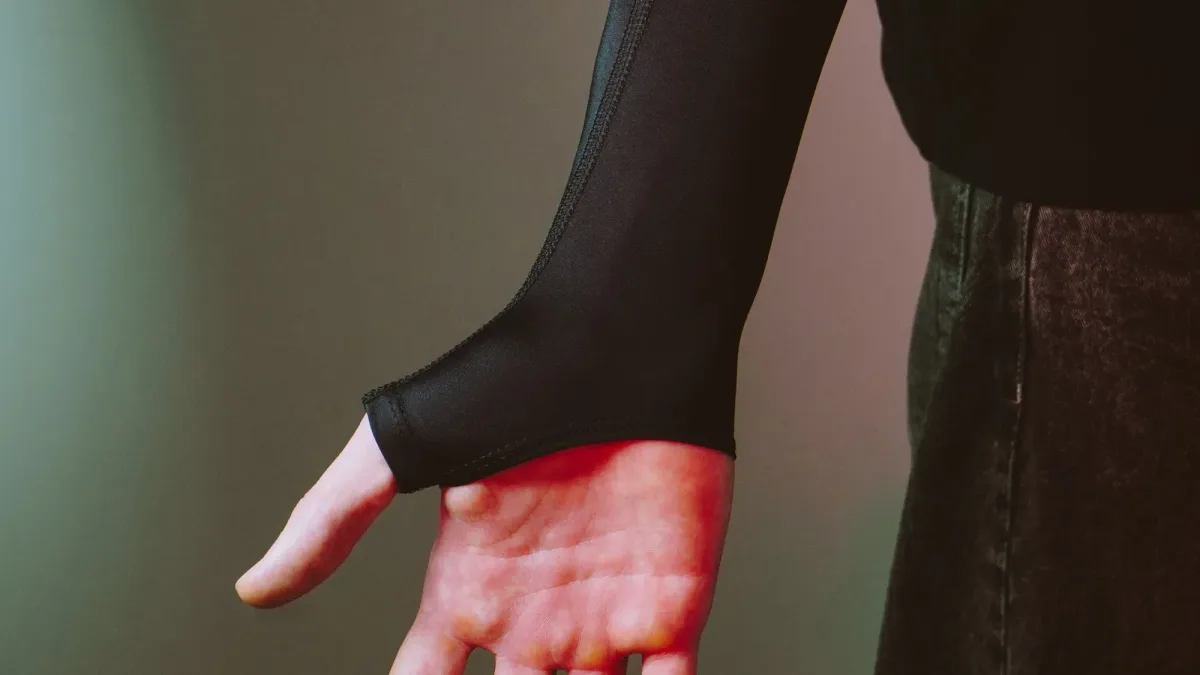
A compression sleeve applies light pressure to the muscles. In theory this might affect circulation in superficial tissue, reduce swelling and muscle vibration, and create a feeling of "support". Which of these works, and how much, is a research question.
What sports research shows
Systematic reviews and meta-analyses of recent years (for example Hill et al., British Journal of Sports Medicine, 2014; Brown et al., Sports Medicine, 2017) reached similar conclusions:
- Recovery after exertion. Compression clothing probably slightly reduces perceived muscle soreness and returns a sense of "freshness" faster after 24–72 hours.
- Performance. The effect on speed, strength or endurance is small or absent, and study quality varies.
- Physiological effects. There are data on small circulation changes in the limbs, but their link to real benefit for a person is not proven.
Studies usually involve runners, cyclists and other sports. You cannot transfer the results directly to computer gamers.
What is known about gamers and mouse work
The static load on the arm during computer play (isometric tension, repetitive movements) differs from athletic loads. There are no quality studies of compression sleeves for exactly this scenario, so claims about their benefit here rest on assumptions or individual reports.
What a sleeve does not do
- It does not treat or prevent carpal tunnel syndrome: there is no evidence, see carpal tunnel syndrome in gamers.
- It does not replace good posture, warm-ups and breaks: hand and wrist warm-up, how long can you play without a break.
- It does not "speed up circulation" enough to feel like an effect: the evidence is limited.
What a sleeve can give
- Comfort and a feeling of support. Some people find it subjectively pleasant.
- Skin protection from friction and sticking, see why your forearm sticks to the desk.
- Glide over the pad.
- Covering tattoos.
These benefits are practical and need no medical promises.
When it is better not to wear one
- If the sleeve squeezes, the hand goes numb or pain appears.
- If the skin is irritated or a rash appears.
- If the sleeve slips and creases.
For pain or numbness do not try to solve the problem with a sleeve: see a doctor. More on forearm pain: forearm pain from the mouse.
How to read claims in advertising
If a maker promises "treatment", "disease prevention" or "improved accuracy", be cautious. A realistic claim reads: "support, comfort, skin protection, glide".
FAQ
Does a sleeve help with hand pain?
Does a sleeve improve circulation?
Does a sleeve prevent carpal tunnel syndrome?
Can a sleeve do harm?
Do I need to wear a sleeve all the time?
Sources
- Hill J. et al. Compression garments and recovery from exercise-induced muscle damage: a meta-analysis. British Journal of Sports Medicine, 2014.
- Brown F. et al. Compression garments and recovery from exercise: a meta-analysis. Sports Medicine, 2017.
- WHO, Ministry of Health of Ukraine, NHS and Mayo Clinic guidance on hand pain and carpal tunnel syndrome.
- This material is informational and does not replace a doctor's advice.
Read also
What Compression Sleeves Are Made Of: Fabric, Density, What to Look For
Read →Sports or Gaming Sleeve: What Is the Difference?
Read →